
I still remember reading about Prince’s private jet making an emergency landing in Illinois several days before he died. The news article didn’t say what was wrong but no later than the article was in print, Prince was on his plane headed back to Minnesota.
He’s going to die. I remember thinking. A plane wouldn’t make an emergency landing unless something were seriously wrong.
Six days later, news was everywhere that Prince had died.
Recently, my husband, son, and I flew to Minnesota as a gift for our son’s high school graduation. We went to the Mall of America, saw my son’s favorite comedian, Gabriel Iglesias, and visited Paisley Park.
Paisley Park was an afterthought because I wasn’t sure I wanted to go. I’d seen pictures of Paisley Park. And because I researched everything about Prince after he died, what could a tour guide tell me that I didn’t already know?
“You can’t go all the way to Minnesota and not see Paisley Park,” my husband said. He knew how much I’d been diving into everything about Prince after his death.
I scheduled the 90 minute tour.
It was worth it.
I wasn’t a Prince superfan. I saw Purple Rain back in the 80s and bought the Purple Rain album. But honestly, Prince was too edgy and sexually charged for my taste. I preferred his cleaner ballads to any of his explicit material, and his albums were always a mix of both, so I passed on all his other projects.
And then there was the era when he changed his name to a symbol and wrote “slave” on the side of his face, and back then I didn’t understand what that was all about. But any time he was on television–awards shows, interviews, and such, I watched because he was Prince, after all. No matter what you thought about him, he was still that icon you wanted to see.
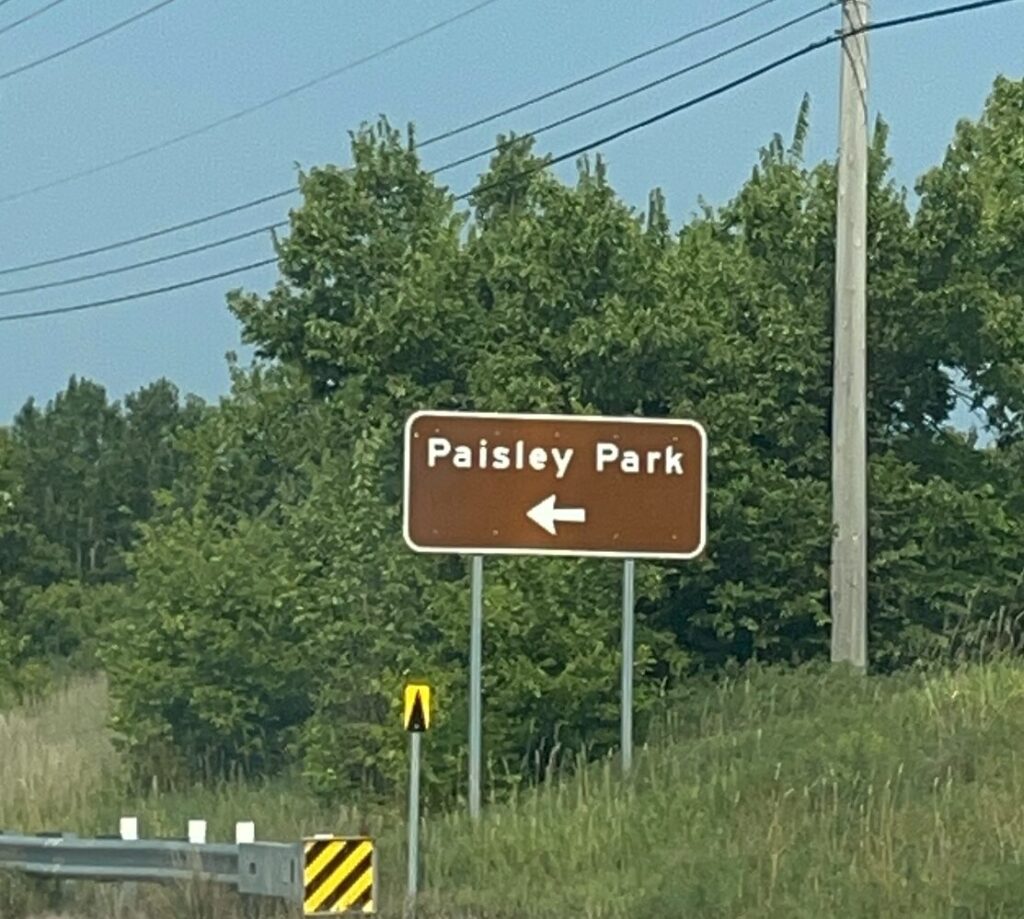
Paisley Park sits right off of Highway 5, now renamed Prince Rogers Nelson Memorial Highway.
As we sat at the light waiting to make the left turn onto Audubon Road, I wondered why Prince chose to build so close to the highway.
I later found out that when Paisley Park was built, it wasn’t a four lane highway, but a two lane road surrounded by cornfields.
Seeing Paisley Park off to the left as we waited at the light brought back memories of when he first died, and news footage showing all the people gathered outside the fence leaving flowers and notes to pay their respects.
He loved his hometown of Minneapolis. And it was clear the people of Minneapolis loved him back. I recall him saying in an Oprah interview, “I’ll always live in Minneapolis.”
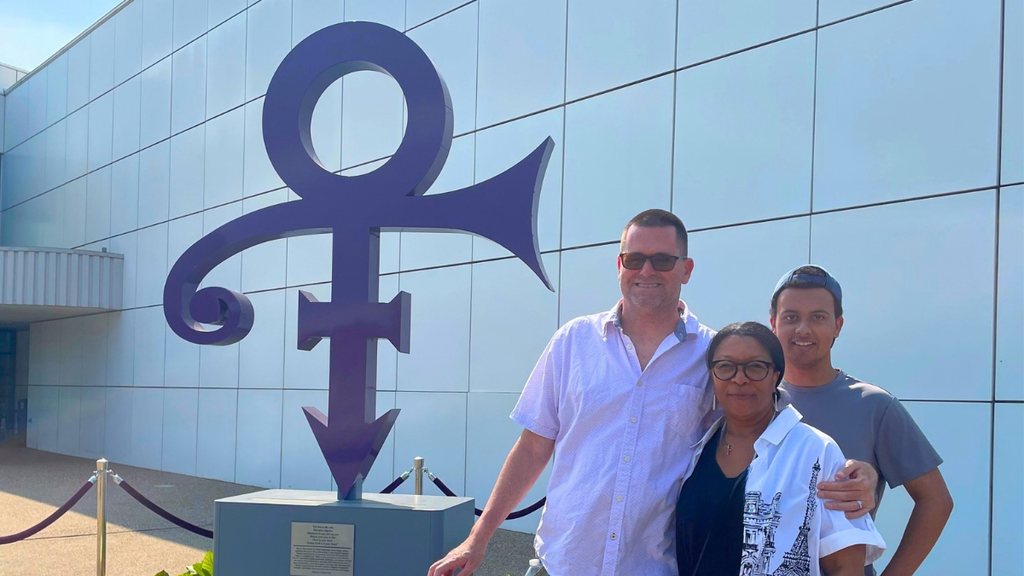
We drove through the gates as a security guard waved us through. A parking lot sits to the left. Paisley Park stands to the right. And you can’t miss the large purple sculpture of the Prince Symbol out front. That was installed after he died, and Prince actually called it the Love Symbol, but I think the Prince Symbol makes more sense since it was the symbol he used to replace his name during his infamous fight with his record company.
Wow. I can’t believe we’re at Paisley Park.
It looks the same, except now I’m standing in front of it taking photos.
It’s been ten years since Prince died. But still, there seemed to be a somberness in the air.
A woman from Texas dressed in purple offered to take our photo next to the Prince Symbol, and we took hers.
As the tour time approached, we walked up to the front doors where a security guard opened the door from the inside. I instinctively reached for my phone to take a photo of him, knowing we’d have to surrender our phones during the tour.
“No photos,” he said before I got the chance. He handed each of us a pouch that would lock our phones away for the duration of the tour.
About twenty-five of us gathered in the reception area. After watching a short video that invited us to leave the outside world behind and enter a place that existed by its own rules, I felt like we were about to enter Willy Wonka’s Chocolate Factory.
I’d never thought it before, but Prince did give off a Willy Wonka vibe. Paisley Park was his version of a Wonka Factory. Willy Wonka was serious about his chocolate factory, and Prince was serious about his music factory. Both were hugely creative, extremely private, controlling, and lived in worlds they created. And yet, both wanted to invite people into those worlds to experience the wonder for themselves. (Oh, and in the 1971 movie Willy Wonka wore purple!)

Our tour guide didn’t seem old enough to know who Prince was, but said her mother had a love for Prince’s music and taught her everything she knew.
She guided us out of the reception area down a dimly lit corridor into a large, contrasting well lit atrium. It instantly felt familiar. The sky blue walls. The white puffy clouds painted onto the sky blue walls. I’d seen it many times in photos. But now I was standing in the room.
Small doorless rooms off to the side caught my eye. There was a bright yellow outfit in one. A drum set in another. I walked over to peek in, but the tour guide directed us to the center of the large space.
Looking all the way up, there’s a cluster of pyramid skylights allowing the light to pour in. Below that, on the second floor mezzanine, there’s a large white bird cage where two white doves are housed.
As our tour guide shared information about that space, I remembered that somewhere in that room on the morning of April 21, 2016 is where Prince was found in the elevator. Dead.
But you’d never know there was an elevator in that room now because a wall was built over it, and it’s covered with all kinds of memorabilia. That’s something I already knew, not something the tour guide told us. The tour was only focused on his music, not his death or his personal life.
Speaking of Prince’s personal life, his private living quarters were on the second floor, which is completely off limits. Surprisingly, the stairs were only blocked off by a thin rope, and it seemed anyone could walk up. There are probably alarms of some sort that would go off if anyone tried.
Originally, Paisley Park was built to only be a massive music production studio allowing Prince and other musicians to record music and film. But he made a portion of the second floor his permanent place of residence in 2005.
After watching a video about Prince’s early start as a musician in Minneapolis, we were allowed some time to peruse the large space on our own for a bit. Then we were led onward to the next part of the tour.
Every part of the tour reflected another part of what Prince created musically.
As we walked through hallways to reach another location, I saw many of Prince’s personal artifacts on walls that were completely unmentioned by the tour guide. Photos. Writings. Notes. Awards. I saw a personal Bible in a recessed wall shelf with a glass covering that intrigued me.
But we had to keep it moving.
We moved through many different hallways to get to other tour destinations that the tour guide had on the agenda, but I wanted so much to slow down and look at every item on the walls. I wanted to see things that would tell us more about Prince the man, not only his music.
Learning more about the circumstances surrounding Prince’s death made me curious about the man behind the public image. Right after he died, I heard people who actually knew him talk about him; people who worked with him, performed with him and some who knew him as a child. The things they said made me want to know more.
So I dug into all things Prince. I watched interviews, read books and articles. I learned more about Prince than I ever wanted to know when he was alive. And the more I learned, the more I began to understand the man I didn’t understand all those years before.
When I read about his battle with his record company, I finally understood why he wrote slave on the side of his face. Even some of the provocative behavior and sexually charged music that made me uncomfortable (and still does) made more sense when I learned about his early life and experiences.
Prince had been on a life journey just like everyone else. He grew. He changed. And he evolved spiritually.
I also heard music and watched performances I hadn’t seen before because he fiercely protected his work when he was alive, and not much of it was online then. I had no idea what an extraordinary guitar player he was.
I didn’t know because I hadn’t been paying attention.
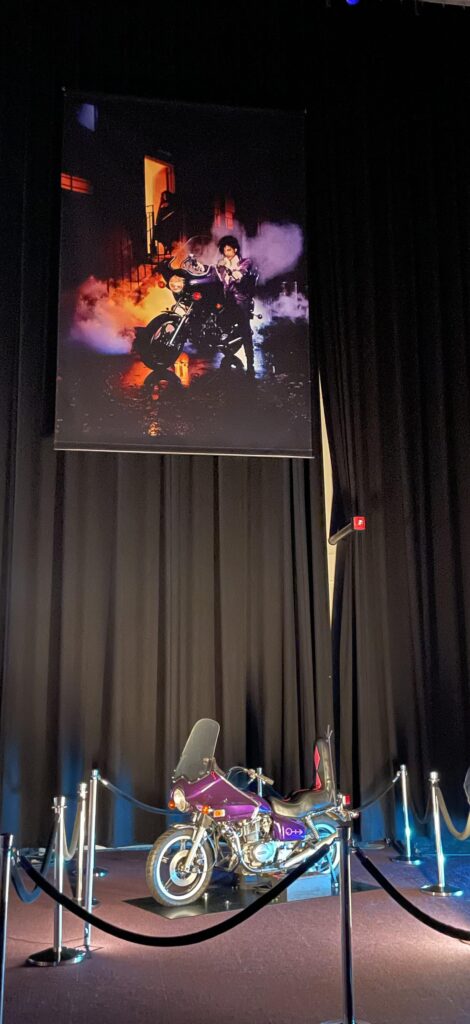
On the last leg of the tour, we entered a huge concert area with a large stage. It’s where Prince would invite the public in for concerts and where he recorded videos for his music. Various displays were set up around the room–personal cars, outfits from his different concert eras, the Purple Rain motorcycle, pianos and other instruments. A large screen above the stage showed Prince in concert.
Our phone pouches were unlocked, and we were now free to take photos.
We were given ample time to walk around the room or watch a bit of the concert on screen before the guide rallied us towards the last stop of the tour.
We stepped into what was originally the NPG Music Club, where Prince held small shows and parties. (NPG or New Power Generation, was the name of the backing band Prince formed after the Purple Rain era, and it’s the name of his own record company.) Since Paisley Park became a museum, it’s now called the NPG Music Cafe, where you can get drinks, sandwiches, snacks, and desserts and relax to Prince music. It’s open to the public even for those who aren’t on a tour.
My husband checked out the cafe menu, but our son was already thinking about Dairy Queen Grill & Chill, so after we looked around in the gift shop, we headed to DQ just down the road from Paisley Park.
Throughout the tour, we saw so much that I can’t remember it all. The guitars. The pianos. The huge sound stage and recording studios. We watched films about Prince and saw handwritten lyrics in his neat cursive.
Those things were cool to see, but the tour was so much more than artifacts, outfits and recording studios.
For me, Paisley Park was a reminder that what Prince became as a successful musician and visionary started a long time ago in his childhood. Being at Prince’s music factory took me back to an interview I saw of him on The Tavis Smiley Show.
When asked how he overcame childhood bullying, Prince explained that he went into himself and focused on teaching himself music. And eventually, instead of people talking about what they could make fun of, they started to say, “Wow, look what he can do.”
And when talking about his father’s harshness, he said something that stayed with me: Prince said he learned to create his own universe, and only allow the people he needed to occupy his universe.
Prince’s responses to those questions speak loudly to how he became who he became.
As a child, Prince focused not on the people who bullied him, but on his God-given gift of music. From a very young age, he created his own universe. He knew he couldn’t control the people who made fun of him, but he knew he could practice, develop his musical abilities, and become a great musician. And he could decide what and who occupied his world.
Paisley Park is seen as Prince’s universe, and it is in a physical sense, but in reality, Prince’s universe existed long before Paisley Park was ever built. Prince’s own universe was his mindset: his creativity, imagination, confidence, determination, the ability to focus and achieve, and the wisdom to only allow those in that he needed.
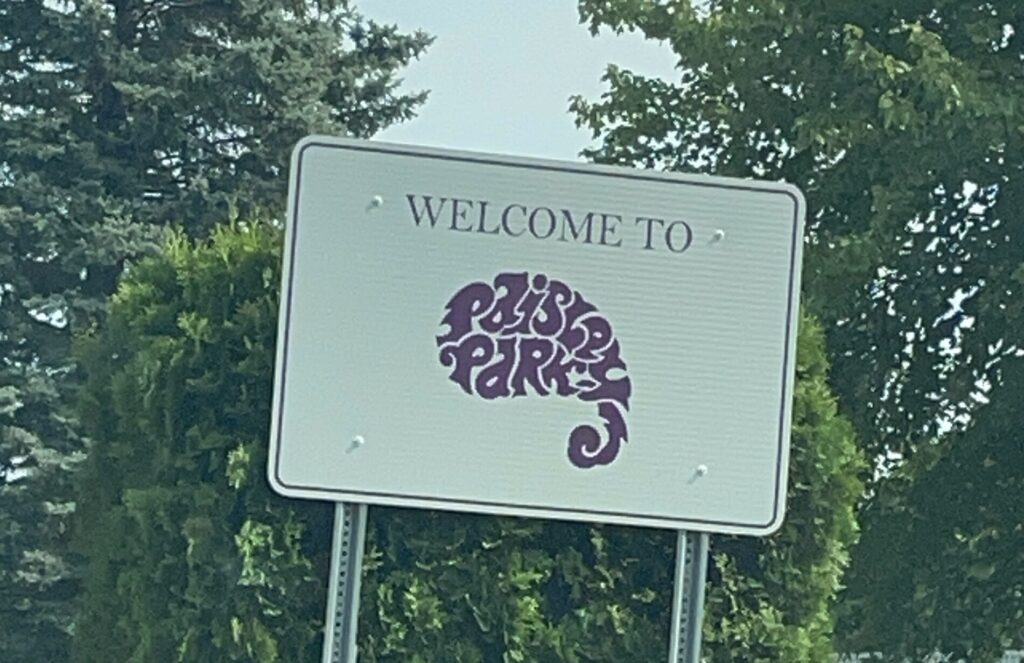
Initially, I wasn’t sure a trip to Paisley Park would be worth it. But it was, and I have my husband to thank for it. He saw what I didn’t see – I’d spent so much time after Prince died discovering who he was that it only made sense to go to Paisley Park while we were in Minnesota.
The tour brought my Prince journey to a full circle.
Creating your own universe is the key to it, and letting all the people that you need occupy that universe.
–Prince